
Why Restricting Food Makes Emotional Eating Worse: How to Break the Cycle and Heal

If you’ve ever found yourself caught in the cycle of emotional eating, you might have considered restricting food as a way to regain control. After all, it seems logical: if you eat less, you’ll eat fewer of those “comfort” foods, right? Unfortunately, restricting food often backfires, leading to even more intense cravings, emotional distress, and a deeper entrenchment in the cycle of emotional eating.
Let’s explore why this happens and, more importantly, what you can do to address the real issues behind emotional eating.
The Vicious Cycle of Restriction and Emotional Eating
When you restrict food, whether by cutting calories, eliminating certain foods, or adhering to strict dietary rules, you’re not just limiting your intake—you’re also triggering a series of psychological and physiological responses that make emotional eating more likely.
Heightened Cravings: Restriction often leads to intense cravings. When your body feels deprived, it starts to crave the very foods you’re trying to avoid, especially those that provide quick comfort, like sweets or high-carb snacks. The more you try to resist, the stronger these cravings can become, setting the stage for binge-eating episodes.
Increased Emotional Distress: Food restriction isn’t just physically taxing—it’s emotionally draining, too. The stress and anxiety of sticking to a restrictive diet can amplify your emotional triggers, making you more likely to turn to food for comfort. The guilt and shame that often follow emotional eating only fuel this distress, perpetuating the cycle.
Disconnection from Hunger Cues: Restricting food can disrupt your natural hunger signals. Over time, you might lose touch with your body’s cues for hunger and fullness, making it harder to distinguish between physical hunger and emotional hunger. This disconnection can lead to eating in response to emotions rather than true physical need.
"I eat my feelings, I just can't help myself. I come home after a long stressful shift and I work nights sometimes so I often skip meals. I'm just so tired and stressed when I come home but I know that crisps, chocolate and wine are waiting for me. In the moment I feel better.. but the guilt kicks in afterwards."
Does this sound like you?
Many people struggle with emotional eating or 'comfort eating' and use food as a self-soothing mechanism for strong emotions.
The difficulty with emotional eating, is that our society shames people for comfort eating, and then pushes them towards dieting or restricting food in an attempt to curb food intake or counter-act emotional eating. This approach actually exacerbates it and often leads to further eating problems (like binge eating disorder, for example).
The approach we take in this Workbook (and the exact approach I use with my coaching clients) is to first increase your emotional awareness through mindfulness and meditation and then help you understand the purpose of even the most negative emotions you feel. We then look at how to build alternative coping strategies to meet your emotional needs and finish off by setting life goals instead of weight-based goals.
In taking this approach, you will no longer feel shamed for comfort eating, or destroy your relationship with food further by dieting. Instead you will feel free of food anxiety, empowered to meet your emotional needs and able to take control of your life path.
_________________________________________________________________________
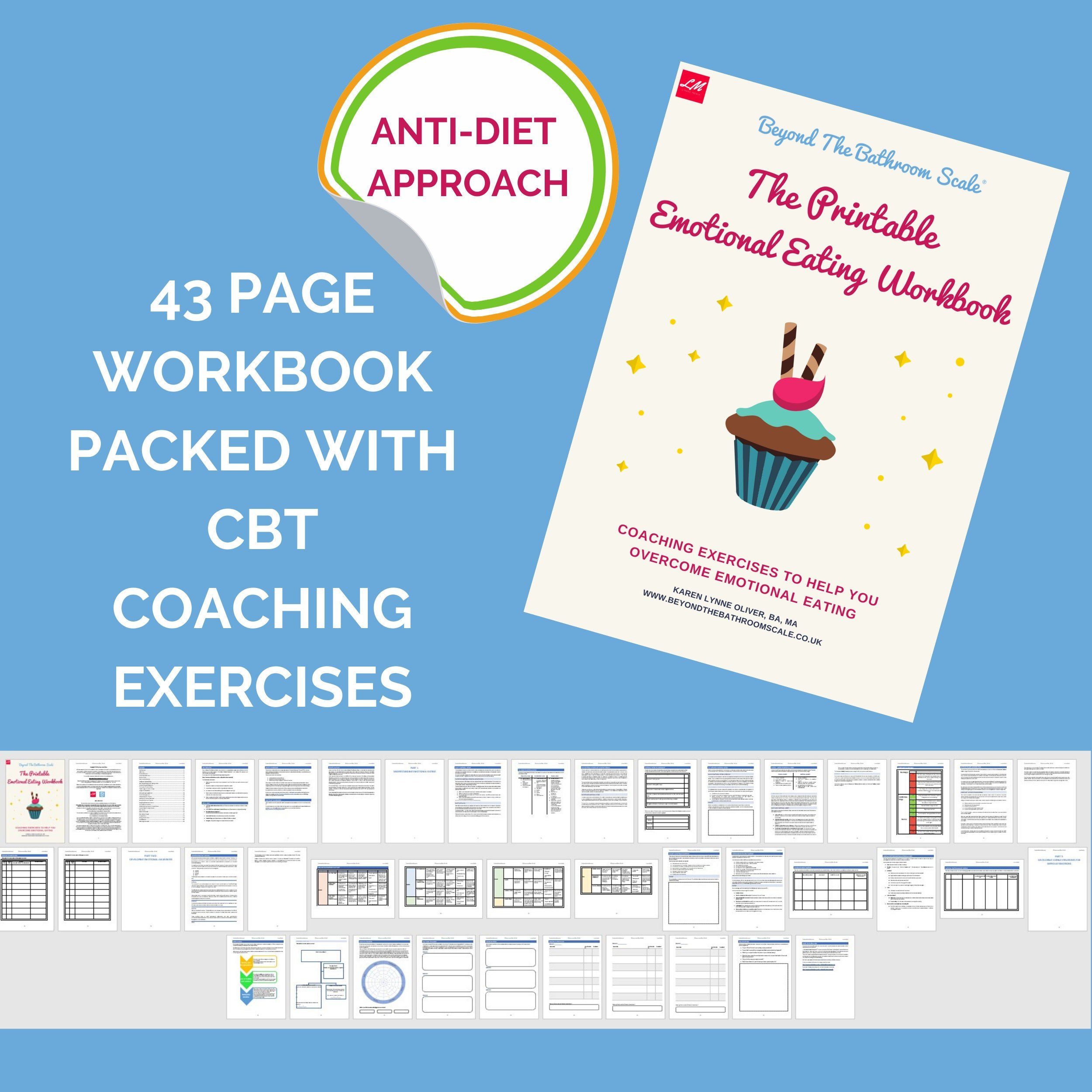
This workbook is packed with coaching exercises based on Cognitive Behavioural Therapy (CBT) to help you better understand the causes of emotional eating and put in place effective alternative, more effective coping strategies for difficult emotions.
This workbook is split into three parts:
1. Understanding Emotional Eating
2. Developing Emotional Awareness
3. Developing Coping Strategies for Difficult Emotions
My approach to Emotional Eating is ‘Anti-Diet’, which means I do not view emotional eating as an ‘eating problem’. Research shows that responding to emotional eating by restricting food intake increases the risk of binge eating and so this is something I strongly advise against when working to overcome emotional eating.
Instead, the focus throughout this workbook will be to become more emotionally aware that we can accurately label our emotions, identify our underlying needs and meet them effectively.
By taking the time to work through the 43 pages of this workbook you will:
--> Understand why dieting or food restriction is NOT a solution to emotional eating (and why it exacerbates it)
--> Understand why you comfort eat and how it's benefiting you (yes, really)
--> Increase your emotional awareness - you'll be able to accurately label what you're feeling and identify the cause of it
--> Develop effective, alternative coping strategies for coping with strong emotions
This workbook is packed with useful ‘cheat sheets’ and worksheets.
___________________________________________________________________________________
TIPS:
This workbook contains a mix of portrait and landscape pages. Please select 'Auto portrait/landscape'
when printing.
You can also print on both sides to save paper.
**No Printer? No problem!**
Your purchase is a digitally fillable pdf, which you can complete using your computer :)
____________________________________________________________________________________
ABOUT THE CREATOR:
Karen Lynne Oliver, BA, MA, is the Founder of Beyond The Bathroom Scale®, a hub of self-help resources to aid with recovery from disordered eating and body image. Karen is also the Programme Director of The Health Mindset Programme™, a 6-month online self-help programme for anyone who wants to improve their body image and relationship with food.
Karen has had articles published in on HuffPost UK and has been featured in The Metro and Cosmopolitan Magazine. Her award-winning blog and coaching programme is based on the Health at Every Size ® approach to health and draws on the principals of Intuitive Eating, the Body Positivity movement, Motivational Interviewing (MI), Positive Psychology and Dialectical Behaviour Therapy (DBT), in order to help busy women tackle disordered eating, overcome emotional eating and recover from long-term dieting via a holistic, research-led online coaching programme.
A former Social Worker, Karen comes from an academic background of Psychology and Sociology. She holds a bachelor’s degree in Sociology, specialising in health and society and a master’s degree in Social Work. She has trained in Counselling skills and Psychotherapy-based approaches such as CBT, DBT and Motivational Interviewing.
______________________________________________________________________________________________________________________________________________________________________
NOT LICENSED FOR PROFESSIONAL USE
To obtain a professional use license, please purchase the workbooks using this link: https://beyondthebathroomscale.co.uk/therapy-workbooks/p/body-image-disordered-eating-cbt-workbooks-digitally-fillable-and-printable-for-professional-use-health-coach-therapist-pt
© Copyright 2020 Beyond The Bathroom Scale® – All Rights Reserved.
"Beyond The Bathroom Scale" is a Registered UK Trademark and the intellectual property of the website owner, Karen Oliver.
We take the protection of our intellectual property very seriously. If we discover that you have breached the terms of the license (as linked to in the footer above), we may bring legal proceedings against you and seek monetary damages and/or an injunction to stop you using our materials. You could also be ordered to pay our legal costs.
Addressing the Root Causes of Emotional Eating
Rather than focusing on food restriction, it’s essential to tackle the underlying emotions and unmet needs that drive emotional eating. Here’s what can help instead:
Develop Emotional Awareness: Start by acknowledging and understanding your emotions. Often, we eat to soothe emotions like stress, loneliness, boredom, or sadness. By increasing your awareness of these feelings, you can begin to address them directly rather than masking them with food.
Practice Self-Compassion: Be kind to yourself. Emotional eating is not a failure; it’s a coping mechanism. Rather than punishing yourself with restrictive diets, practice self-compassion. Understand that it’s okay to have emotions, and it’s okay to seek comfort—but there are healthier ways to do so.
Find Alternative Coping Mechanisms: Identify activities that bring you comfort and joy without involving food. This could be anything from taking a walk, calling a friend, journaling, or engaging in a creative hobby. These alternatives help you process emotions without turning to food.
Rebuild Trust with Your Body: Work on reconnecting with your body’s natural hunger and fullness cues. This means eating when you’re hungry, stopping when you’re full, and allowing yourself to enjoy all types of food without guilt. Over time, this will help you develop a more intuitive and balanced relationship with food.
Seek Support: You don’t have to navigate this journey alone. Whether it’s through friends, family, or professional help, seeking support can provide you with the encouragement and tools needed to manage emotional eating more effectively.
Embrace a Compassionate Approach to Emotional Eating
If you’re ready to move away from restrictive dieting and toward a more compassionate, effective approach to emotional eating, our Emotional Eating course is here to guide you.
The Emotional Eating course is designed to help you understand and overcome emotional eating with compassion and practical guidance. This video-based course, enriched with cognitive-behavioural therapy (CBT) workbooks, offers a comprehensive approach to addressing the complex relationship between emotions and eating.
In this course, you will:
Understand Emotional Eating: Learn to recognize the difference between emotional and physical hunger.
Increase Emotional Awareness: Enhance your ability to identify and understand your feelings.
Develop Coping Strategies: Implement effective strategies to manage difficult emotions without turning to food.
Join us today and take the first step toward a more fulfilling, balanced life where you can address emotional eating with confidence and compassion.

Based on CBT, this course will help you uncover the causes behind emotional binge eating and the strategies for tackling it. Often, it's viewed as an eating problem when, in fact, it's a sign that self-care and mental well-being need to be prioritized. We'll work together to develop alternative coping mechanisms for strong emotions, drawing on the same strategies you would be taught in Cognitive Behavioural Therapy.