
How to Practice Mindful Eating for Holistic Wellness: Benefits and Tips for a Balanced Life

In a world brimming with distractions, eating mindfully can be a transformative practice for enhancing your overall well-being. Mindful eating isn’t just about savouring each bite; it’s a holistic approach that fosters a deeper connection between your mind, body, and food. Embracing mindful eating can significantly enrich your life, promoting balance and harmony within. Here’s how to practice mindful eating and the myriad benefits it offers for mind-body wellness.
1. Slow Down and Savor Your Food
One of the core principles of mindful eating is to slow down and fully engage with your food. Take the time to appreciate the colours, textures, and aromas of each dish. By eating slowly and savouring each bite, you give your body a chance to register satiety signals and prevent overeating. This practice not only enhances your enjoyment of food but also supports better digestion and overall satisfaction.
2. Tune Into Your Hunger and Fullness Cues
Mindful eating encourages you to listen to your body's natural hunger and fullness cues. Before you eat, assess how hungry you are on a scale from 1 to 10. During your meal, check in with yourself regularly to gauge your level of fullness. By attuning to these signals, you can make more informed decisions about when to eat and when to stop, fostering a healthier relationship with food.
3. Minimize Distractions
To practice mindful eating, create an environment that minimizes distractions. Turn off the TV, put away your phone, and focus solely on your meal. By eating without multitasking, you can fully immerse yourself in the sensory experience of eating, making each meal a mindful ritual rather than a hurried task.
4. Engage Your Senses
Engage all your senses while eating to deepen your mindfulness. Notice the texture of the food as you chew, the flavour profiles that unfold with each bite, and the aromas that waft from your plate. This sensory engagement helps you connect more deeply with your meal and fosters a greater appreciation for the nourishment it provides.
5. Practice Gratitude
Before eating, take a moment to express gratitude for your food. Reflect on the effort that went into preparing the meal, from the farmers who grew the ingredients to the cook who prepared it. Cultivating gratitude for your food can enhance your mindfulness practice and foster a positive relationship with eating.
“Food is always on my mind. I feel out-of-control around my favourite foods, I always end up binging on them when I finally let myself have them. I worry about calories and macros and track them using an app. I have a long history of dieting which started when I was a teenager. I feel like food probably isn’t this big of a deal for other people, I wish I could relax around it like they seem to.”
Does this sound like you?
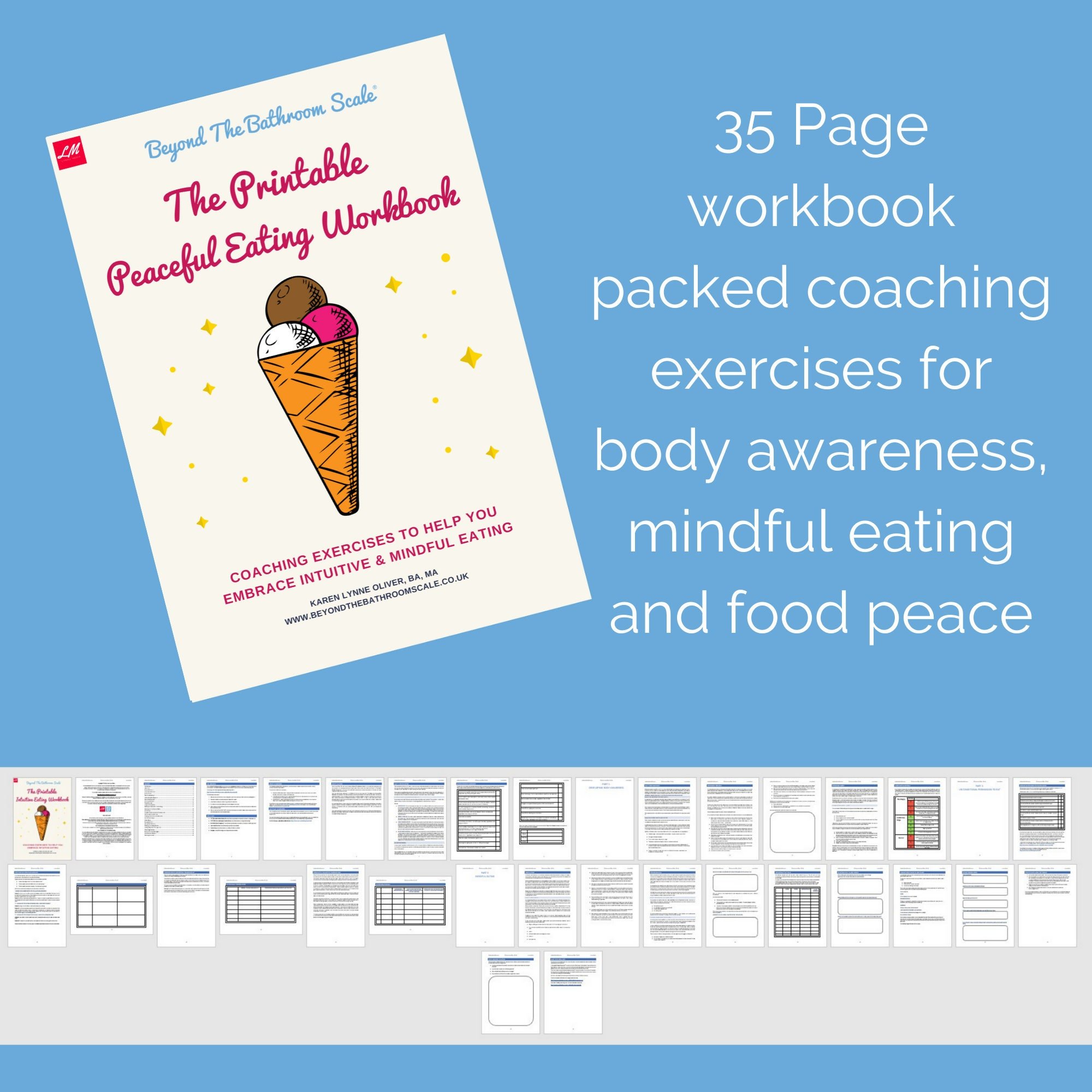
The Printable Peaceful Eating Workbook for people who want to leave diets behind once and for all and embrace Intuitive and Mindful Eating instead.
The workbook is split into three parts:
1. Developing Body Awareness – these exercises are designed to help you check in with your body’s signals, including your hunger and fullness cues.
2. Unconditional Permission to Eat – these exercises will help you understand and ditch the food rules you’ve adopted from past diets and diet culture.
3.Mindful Eating – these final exercises will help you find enjoyment and satisfaction from food and listen out for pesky thoughts of diets creeping back into your mind.
This workbook is packed with useful ‘cheat sheets’ and worksheets for you to print and make copies of.
You could create your own binder of self-help resources for your mental wellbeing and personal development and add to them using additional workbooks available on the Lynne Media Etsy Store.
__________________________________________________________________________________________________
TIPS:
This workbook contains a mix of portrait and landscape pages. Please select 'Auto portrait/landscape'
when printing.
You can also print on both sides to save paper.
**No Printer? No problem!**
Your purchase is a digitally fillable pdf, which you can complete using your computer :)
ABOUT THE CREATOR:
Karen Lynne Oliver, BA, MA, is the Founder of Beyond The Bathroom Scale®, a hub of self-help resources to aid with recovery from disordered eating and body image. Karen is also the Programme Director of The Health Mindset Programme™, a 6-month online self-help programme for anyone who wants to improve their body image and relationship with food.
Karen has had articles published in on HuffPost UK and has been featured in The Metro and Cosmopolitan Magazine. Her award-winning blog and coaching programme is based on the Health at Every Size ® approach to health and draws on the principles of Intuitive Eating, the Body Positivity movement, Motivational Interviewing (MI), Positive Psychology and Dialectical Behaviour Therapy (DBT), in order to help busy women tackle disordered eating, overcome emotional eating and recover from long-term dieting via a holistic, research-led online coaching programme.
A former Social Worker, Karen comes from an academic background of Psychology and Sociology. She holds a bachelor’s degree in Sociology, specialising in health and society and a master’s degree in Social Work. She has trained in Counselling skills and Psychotherapy-based approaches such as CBT, DBT and Motivational Interviewing.
______________________________________________________________________________________________________________________________________________________________________
NOT LICENSED FOR PROFESSIONAL USE
To obtain a professional use license, please purchase the workbooks using this link: https://beyondthebathroomscale.co.uk/therapy-workbooks/p/body-image-disordered-eating-cbt-workbooks-digitally-fillable-and-printable-for-professional-use-health-coach-therapist-pt
© Copyright 2020 Beyond The Bathroom Scale® – All Rights Reserved.
"Beyond The Bathroom Scale" is a Registered UK Trademark and the intellectual property of the website owner, Karen Oliver, trading as Beyond The Bathroom Scale, part of Lynne Media ('our', 'we', 'us').
We take the protection of our intellectual property very seriously. If we discover that you have breached the terms of the license, we may bring legal proceedings against you and seek monetary damages and/or an injunction to stop you using our materials. You could also be ordered to pay our legal costs.
6. Observe Your Emotional State
Mindful eating also involves being aware of your emotional state during meals. Notice if you are eating out of stress, boredom, or genuine hunger. By observing your emotions, you can start to address underlying issues and develop healthier eating habits that are driven by physical needs rather than emotional triggers.
7. Enjoy a Variety of Foods
Incorporate a variety of foods into your diet to enrich your mindful eating experience. Explore different textures, flavours, and cuisines to keep your meals exciting and satisfying. A diverse diet not only ensures you receive a range of nutrients but also enhances your enjoyment and engagement with food.
8. Reflect on Your Eating Experience
After your meal, take a few moments to reflect on your eating experience. Consider how you felt during the meal, what you enjoyed, and any insights gained. This reflection can help you identify patterns and make adjustments to improve your mindful eating practice over time.
9. Practice Self-Compassion
Be kind to yourself throughout your mindful eating journey. It’s natural to have moments where you eat mindlessly or feel disconnected from your body’s cues. Practice self-compassion by gently redirecting yourself back to mindful eating without judgment or frustration.
10. Integrate Mindful Eating Into Your Lifestyle
Finally, make mindful eating a consistent part of your daily life. Incorporate these practices into your routine, and gradually build habits that support a mindful approach to food. Over time, mindful eating can become a natural and enriching aspect of your lifestyle, contributing to overall well-being.
Explore Our Intuitive Eating Course for Further Guidance
Mindful eating is a powerful tool for holistic wellness, and our Intuitive Eating Course can provide you with further support on this journey. In this course, you'll learn to embrace intuitive eating principles, understand your body's hunger cues, and build a healthier relationship with food. With video lessons and practical workbooks, our course offers compassionate guidance and practical strategies to help you integrate mindful eating into your life.
Embrace the opportunity to deepen your mindful eating practice. Explore our Intuitive Eating Course and discover how to foster a nurturing and balanced relationship with food, enhancing both your mental and physical well-being. Your journey to holistic wellness starts here.

In this course, we'll cover what is meant by Intuitive Eating and how it can help you gain freedom from dieting and improve your relationship with food and your body. We'll cover the main principles of intuitive eating and learn how to avoid turning it into 'just another diet'. We'll look at what the tools of dieting look like, analyse your personal dieting history and examine the dieting mentality and you'll learn to listen to what your body is trying to tell you it needs most.