
How to Start Your Intuitive Eating Journey: Essential Tips for Beginners Transitioning from Dieting

Embarking on a journey from dieting to intuitive eating is like stepping into a new, liberating world where you’re the expert on your own needs. If you’ve spent years chasing after restrictive diets and grappling with conflicting nutrition advice, transitioning to intuitive eating might feel both exhilarating and daunting. But take a deep breath—this shift is all about reconnecting with your body’s wisdom and nurturing a healthier, more compassionate relationship with food. Let’s explore some actionable steps to help you get started on this transformative path.
1. Reframe Your Mindset
Before diving into the practical aspects of intuitive eating, it's essential to cultivate a mindset of curiosity and self-compassion. Let go of the guilt or shame that may come from past dieting experiences. Instead, approach this journey with an open heart and a sense of wonder. Remember, intuitive eating is about finding peace with food, not adhering to a set of rigid rules.
Action Step: Start by journaling about your past experiences with dieting. What did you learn? What emotions are tied to those experiences? Use this reflection to guide your new, compassionate mindset.
2. Learn the Principles of Intuitive Eating
Intuitive eating is guided by ten core principles, based on the book ‘Intuitive Eating’ by Evelyn Tribole and Elyse Resch, each designed to help you reconnect with your body's natural hunger and fullness cues. Familiarize yourself with these principles:
Reject the Diet Mentality: Let go of the idea that diets are the answer to your problems.
Honor Your Hunger: Eat when you’re hungry, not just when it’s "time" to eat.
Make Peace with Food: Allow yourself to enjoy all foods without guilt.
Challenge the Food Police: Silence the critical voice that judges your food choices.
Respect Your Fullness: Pay attention to your body’s signals of fullness.
Discover the Satisfaction Factor: Find joy and satisfaction in eating.
Honor Your Feelings Without Using Food: Understand emotional eating and find alternative coping strategies.
Respect Your Body: Accept and love your body as it is.
Exercise—Feel the Difference: Focus on how movement makes you feel rather than burning calories.
Honor Your Health: Make food choices that make you feel good without compromising joy.
Action Step: Pick one principle each week to focus on. For instance, start with “Honor Your Hunger” and practice listening to your body’s signals about when and how much to eat.
3. Dismantle the Diet Mentality
To fully embrace intuitive eating, it’s crucial to dismantle the diet mentality. This means challenging the diet culture’s belief that there’s a “perfect” way to eat and that certain foods are inherently “bad.” Start by unfollowing social media accounts or discarding magazines that perpetuate diet myths. Surround yourself with positive, body-affirming messages.
Action Step: Create a vision board or a digital collage of body-positive images and affirmations that inspire you. Let this be a daily reminder of your commitment to self-acceptance and holistic wellness.
4. Reconnect with Your Body
Intuitive eating requires tuning into your body’s signals. This can be challenging if you’ve been accustomed to ignoring or overriding your hunger and fullness cues. Begin by practicing mindfulness during meals—savor each bite, and notice how different foods make you feel physically and emotionally.
Action Step: Try eating one meal a day in a distraction-free environment. Focus on the textures, flavors, and sensations of the food. Pay attention to how your body responds.
“Food is always on my mind. I feel out-of-control around my favourite foods, I always end up binging on them when I finally let myself have them. I worry about calories and macros and track them using an app. I have a long history of dieting which started when I was a teenager. I feel like food probably isn’t this big of a deal for other people, I wish I could relax around it like they seem to.”
Does this sound like you?
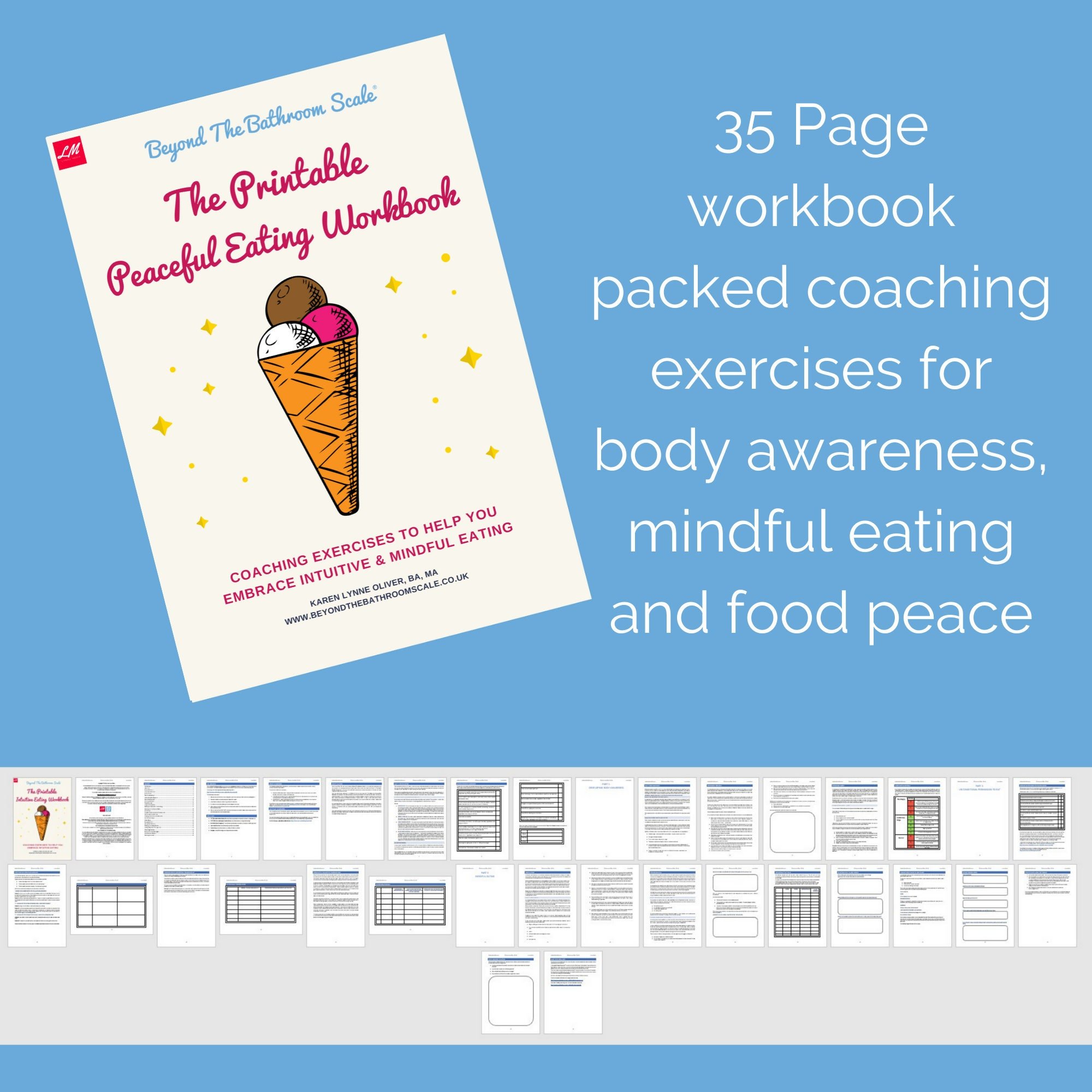
The Printable Peaceful Eating Workbook for people who want to leave diets behind once and for all and embrace Intuitive and Mindful Eating instead.
The workbook is split into three parts:
1. Developing Body Awareness – these exercises are designed to help you check in with your body’s signals, including your hunger and fullness cues.
2. Unconditional Permission to Eat – these exercises will help you understand and ditch the food rules you’ve adopted from past diets and diet culture.
3.Mindful Eating – these final exercises will help you find enjoyment and satisfaction from food and listen out for pesky thoughts of diets creeping back into your mind.
This workbook is packed with useful ‘cheat sheets’ and worksheets for you to print and make copies of.
You could create your own binder of self-help resources for your mental wellbeing and personal development and add to them using additional workbooks available on the Lynne Media Etsy Store.
__________________________________________________________________________________________________
TIPS:
This workbook contains a mix of portrait and landscape pages. Please select 'Auto portrait/landscape'
when printing.
You can also print on both sides to save paper.
**No Printer? No problem!**
Your purchase is a digitally fillable pdf, which you can complete using your computer :)
ABOUT THE CREATOR:
Karen Lynne Oliver, BA, MA, is the Founder of Beyond The Bathroom Scale®, a hub of self-help resources to aid with recovery from disordered eating and body image. Karen is also the Programme Director of The Health Mindset Programme™, a 6-month online self-help programme for anyone who wants to improve their body image and relationship with food.
Karen has had articles published in on HuffPost UK and has been featured in The Metro and Cosmopolitan Magazine. Her award-winning blog and coaching programme is based on the Health at Every Size ® approach to health and draws on the principles of Intuitive Eating, the Body Positivity movement, Motivational Interviewing (MI), Positive Psychology and Dialectical Behaviour Therapy (DBT), in order to help busy women tackle disordered eating, overcome emotional eating and recover from long-term dieting via a holistic, research-led online coaching programme.
A former Social Worker, Karen comes from an academic background of Psychology and Sociology. She holds a bachelor’s degree in Sociology, specialising in health and society and a master’s degree in Social Work. She has trained in Counselling skills and Psychotherapy-based approaches such as CBT, DBT and Motivational Interviewing.
______________________________________________________________________________________________________________________________________________________________________
NOT LICENSED FOR PROFESSIONAL USE
To obtain a professional use license, please purchase the workbooks using this link: https://beyondthebathroomscale.co.uk/therapy-workbooks/p/body-image-disordered-eating-cbt-workbooks-digitally-fillable-and-printable-for-professional-use-health-coach-therapist-pt
© Copyright 2020 Beyond The Bathroom Scale® – All Rights Reserved.
"Beyond The Bathroom Scale" is a Registered UK Trademark and the intellectual property of the website owner, Karen Oliver, trading as Beyond The Bathroom Scale, part of Lynne Media ('our', 'we', 'us').
We take the protection of our intellectual property very seriously. If we discover that you have breached the terms of the license, we may bring legal proceedings against you and seek monetary damages and/or an injunction to stop you using our materials. You could also be ordered to pay our legal costs.
5. Develop a Positive Relationship with Food
Start viewing food as nourishment and pleasure rather than as a source of guilt or anxiety. Allow yourself to eat without judgment, and experiment with different types of foods to see what makes you feel your best. Remember, all foods can fit into a balanced diet.
Action Step: Plan a meal where you include a variety of foods you enjoy. Embrace the experience without any negative self-talk. Celebrate the meal as a moment of self-care.
6. Find Support and Build a Community
Navigating intuitive eating alone can be challenging, so seek out supportive communities or individuals who share similar goals. Whether it’s an online group, a therapist specializing in intuitive eating, or friends who understand your journey, connecting with others can provide encouragement and accountability.
Action Step: Join a local or online intuitive eating group. Share your experiences, ask questions, and offer support to others on a similar path.
7. Be Patient and Compassionate with Yourself
Transitioning to intuitive eating is a process, and it’s okay to stumble along the way. Celebrate your progress, no matter how small, and practice self-compassion when things don’t go as planned. Your journey is unique, and every step forward is a victory.
Action Step: Keep a gratitude journal where you note down positive changes or insights you gain each week. Reflecting on these can help reinforce your commitment to intuitive eating.
8. Embrace the Joy of Eating
Finally, allow yourself to rediscover the joy of eating. Let food be a source of pleasure and connection, not just sustenance. Explore new recipes, savor your favorite dishes, and share meals with loved ones. Eating is an integral part of life—make it a joyful experience.
Action Step: Plan a “joyful meal” where you cook or order your favorite dishes and enjoy them with loved ones. Focus on the pleasure and connection that come from sharing good food.
If you’re ready to begin your Intuitive Eating journey, start by tuning into your body’s signals and giving yourself permission to eat the foods you love without judgment. Remember, this is a process, and it’s okay to take it one step at a time. Surround yourself with supportive resources, and be kind to yourself as you navigate this new way of eating.
At its core, Intuitive Eating is about reconnecting with your body’s natural wisdom and fostering a relationship with food that is free from guilt and shame. It’s an invitation to trust yourself, nourish your body, and find joy in eating again.
Ready to dive deeper? Join our comprehensive Intuitive Eating course, where you'll get access to video lessons, practical workbooks, and personalized guidance to support your journey. This course is designed to empower you with the tools and confidence to embrace food freedom and build a positive, lasting relationship with your body. Enroll today and start transforming your approach to eating and well-being.

In this course, we'll cover what is meant by Intuitive Eating and how it can help you gain freedom from dieting and improve your relationship with food and your body. We'll cover the main principles of intuitive eating and learn how to avoid turning it into 'just another diet'. We'll look at what the tools of dieting look like, analyse your personal dieting history and examine the dieting mentality and you'll learn to listen to what your body is trying to tell you it needs most.